
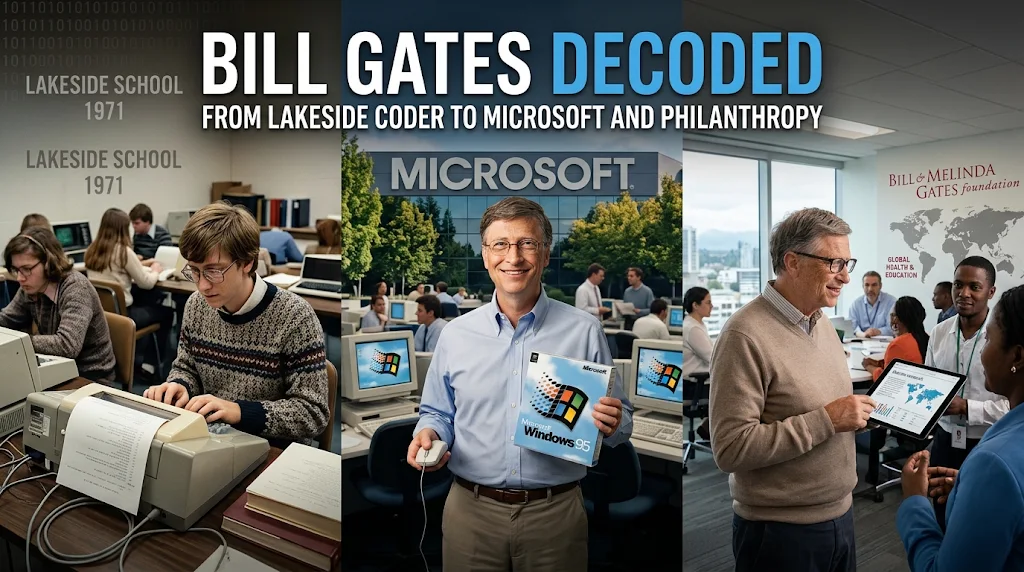
Bill Gates helped put a computer on nearly every desk in the world, became the richest person on the planet for much of two decades, and then decided to spend most of his fortune on global health and development. This Bill Gates biography decodes the curious childhood, the partnership with Paul Allen, the rise and legal battles of Microsoft, and the second career that has made him one of the most influential philanthropists in history.
Bill Gates Biography: Key Facts
William Henry Gates III was born on October 28, 1955, in Seattle, Washington. His father, William H. Gates Sr., was a prominent lawyer, and his mother, Mary Maxwell Gates, served on corporate and charity boards, including the national board of United Way. He has two sisters, Kristianne and Libby, and grew up in a competitive, close-knit family that loved games, puzzles and dinner-table debate.
| Fact | Details |
|---|---|
| Full name | William Henry Gates III |
| Date of birth | October 28, 1955 |
| Birthplace | Seattle, Washington, USA |
| Zodiac sign | Scorpio |
| Education | Lakeside School; Harvard University (left in 1975) |
| Company | Microsoft, co-founded in 1975 with Paul Allen |
| Foundation | Gates Foundation, created in 2000 |
| Former spouse | Melinda French Gates (married 1994, divorced 2021) |
| Children | Jennifer, Rory and Phoebe |
A Restless Kid in Seattle
Young Bill read constantly, from encyclopedias to science fiction, and could be difficult at school when he was bored. His parents sent him to Lakeside, a private school in Seattle, when he was 13. In 1968 the school’s Mothers’ Club used money from a rummage sale to buy computer time on a terminal connected to a mainframe, and Gates was hooked immediately. He wrote his first program, a tic-tac-toe game, and spent nights and weekends coding.
At Lakeside he met Paul Allen, two years older and equally obsessed with computers. The pair found bugs in a local company’s systems in exchange for free computer time, wrote a class-scheduling program for the school and started a small venture called Traf-O-Data that analyzed traffic counts. It was not a big success, but it taught them how to build and sell software.
Early Bill Gates Biography Milestones
- 1955: born in Seattle, Washington.
- 1968: first uses a computer terminal at Lakeside School.
- 1973: enrolls at Harvard University.
- 1975: leaves Harvard and co-founds Microsoft with Paul Allen.
- 1980: agrees to supply an operating system for IBM’s first personal computer.
Harvard and the Birth of Microsoft
Gates enrolled at Harvard in 1973. In December 1974, Allen showed him a magazine cover featuring the Altair 8800, one of the first personal computer kits. The two contacted its maker, MITS, and claimed they had a version of the BASIC programming language ready for it, even though they had not yet written it. They delivered a working version within weeks. In April 1975 they founded Micro-Soft in Albuquerque, New Mexico, and Gates soon left Harvard to run the company.
The IBM Deal and Windows
Microsoft moved to the Seattle area in 1979. The turning point came in 1980, when IBM needed an operating system for its upcoming personal computer. Microsoft bought an existing system called 86-DOS, adapted it into MS-DOS and licensed it to IBM while keeping the right to sell it to other manufacturers. As IBM-compatible computers spread, MS-DOS became the standard, and Microsoft grew with them.
Windows, launched in 1985, eventually brought a graphical interface to most of the world’s PCs. Microsoft went public in 1986, making Gates a billionaire by age 31. Windows 95 became a global event, and Microsoft Office became the standard set of tools for businesses everywhere.
| Year | Milestone |
|---|---|
| 1975 | Microsoft founded in Albuquerque |
| 1981 | MS-DOS ships with the IBM PC |
| 1985 | First version of Windows released |
| 1986 | Microsoft goes public |
| 1995 | Windows 95 launches |
| 2000 | Gates steps down as CEO; Steve Ballmer takes over |
| 2008 | Gates leaves his daily role at Microsoft |
| 2020 | Gates leaves Microsoft’s board |
Antitrust Battles
Microsoft’s dominance drew legal challenges. In 1998 the US Department of Justice and several states sued the company, arguing that it used its Windows monopoly to crush competitors, especially in web browsers. A judge initially ordered Microsoft to be broken up, but the decision was overturned on appeal, and the case ended with a settlement in 2001 that placed restrictions on the company’s behavior. Gates’s combative videotaped testimony damaged his public image at the time.
A Second Career in Philanthropy
Gates stepped down as CEO in 2000 and left his full-time role in 2008 to focus on the Bill & Melinda Gates Foundation, now called the Gates Foundation. It has become one of the largest private charitable organizations in the world, funding vaccines, efforts against malaria and polio, agricultural research and education. In 2010 Gates and Warren Buffett launched the Giving Pledge, inviting billionaires to commit to giving away most of their wealth. In 2025 Gates announced that the foundation would spend about 200 billion dollars over the next two decades and then close.
Ideas That Shape the Bill Gates Biography Today
- Fighting infectious diseases such as polio and malaria.
- Climate technology through Breakthrough Energy, founded in 2015.
- Book recommendations shared on his blog, Gates Notes.
- Writing books, including the memoir Source Code (2025) about his early years.
Working Style and Habits
In Microsoft’s early years Gates was known for working through the night, sleeping under his desk and memorizing employees’ license plates to see who arrived early. He reviewed code personally and could be blunt in meetings, sometimes challenging engineers with sharp questions. Former colleagues say that intensity set the tone for a company culture built on technical excellence and fierce competition.
Today he is known for reading constantly, often taking a large bag of books on vacation, and for “think weeks,” periods he sets aside to read papers and reflect on big problems without interruption. He shares many of his reading lists publicly, and his recommendations regularly push books onto bestseller lists.
Partnership with Paul Allen
Paul Allen was essential to Microsoft’s founding vision, but the two had a complicated relationship. Allen left the company in 1983 after being diagnosed with Hodgkin’s lymphoma, and in his own memoir he wrote that Gates had pushed to reduce his ownership stake. Despite that tension, the two remained friends, and Gates spoke warmly about him after Allen’s death in 2018, describing him as the person who made it all possible.
Predictions and Public Voice
Gates has become a prominent commentator on technology and the future. In a 2015 talk he warned that the world was not prepared for a global pandemic, a speech that drew wide attention in 2020. He writes regularly about artificial intelligence, climate change and global health, arguing that innovation can solve many large problems if governments and businesses invest in it. His high profile has also made him a target of conspiracy theories, which he has repeatedly rejected.
Wealth and Giving
Gates was ranked the world’s richest person for most years between 1995 and 2017, according to Forbes. He has transferred large amounts of his Microsoft shares to his foundation over time, and his net worth has fallen in rankings as he gives more away. He has said he wants to give away almost all of his fortune during his lifetime rather than leave it to his children.
Family and Personal Life
Gates married Melinda French, a Microsoft product manager, in 1994 on the Hawaiian island of Lanai. They had three children: Jennifer, born in 1996; Rory, born in 1999; and Phoebe, born in 2002. The couple announced their divorce in 2021 and have continued to talk publicly about their respect for each other. Gates has since appeared in public with Paula Hurd and has become a grandfather.
FAQ
How old is Bill Gates?
He was born on October 28, 1955, so he turned 71 in October 2026.
Did Bill Gates graduate from Harvard?
No. He left in 1975 to build Microsoft. Harvard gave him an honorary degree in 2007.
Who founded Microsoft with Bill Gates?
His childhood friend Paul Allen, whom he met at Lakeside School.
When did Bill Gates leave Microsoft?
He stepped down as CEO in 2000, left his daily role in 2008 and left the board in 2020.
How many children does Bill Gates have?
Three: Jennifer, Rory and Phoebe.
What does the Gates Foundation do?
It funds global health, development, agriculture and education programs, with a focus on fighting disease and poverty.
What is Bill Gates’s memoir called?
Source Code: My Beginnings, published in 2025.
Conclusion
Bill Gates turned a teenage obsession with computers into a company that shaped modern life, then turned his fortune toward problems that markets often ignore. His career has included brilliant deals, fierce competition and serious criticism, as well as some of the largest charitable commitments in history. Few people have influenced both technology and global health on such a scale, and his decision to close his foundation by 2045 means the biggest chapter of his giving is still being written. For anyone curious about how modern computing and modern philanthropy took shape, his life story is an essential place to start.